Quick answer: If you finance trucks, LCVs or buses, your loan software has to do far more than book EMIs. It should value the vehicle, run separate credit policies for first-time users and fleet owners, schedule EMIs around freight cycles, track RC hypothecation, power field collections and tag SMA/NPA at day-end. Here are the 7 features to check before you sign with a vendor.
You already know CV lending is its own business. Your borrower may be a first-time user with one truck, a small fleet owner with five, or a transporter adding capacity. Income moves with market load, freight rates and diesel prices. The asset depreciates and crosses state lines. And a good share of collections still happens in the field, often in cash.
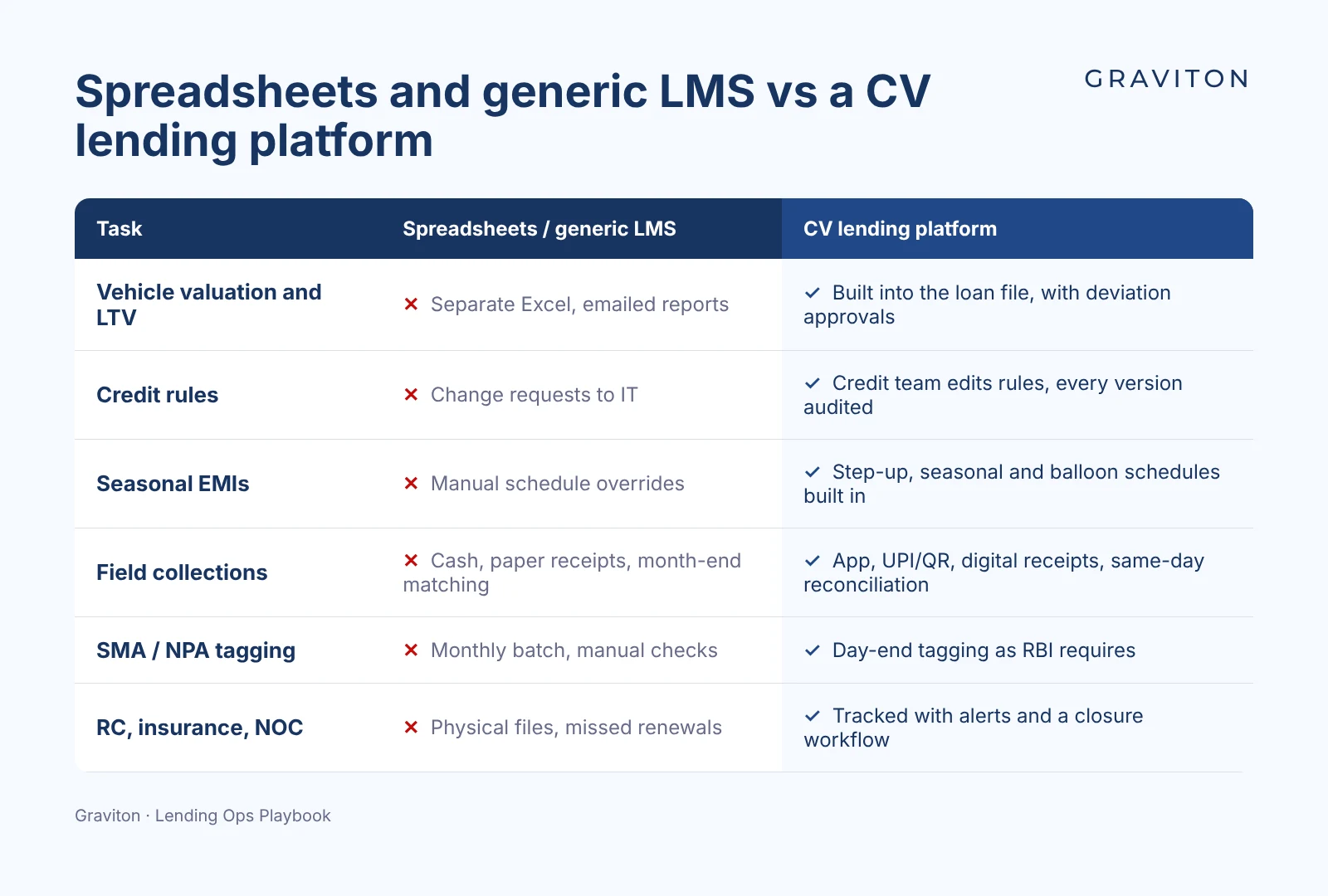
Yet many CV lenders still run this on a retail LMS plus spreadsheets. The result: longer sanction TAT, dealers waiting for payouts, collections reconciled at month-end, and stressed accounts spotted late. With analysts expecting continued pressure on CV and used-CV books from fuel prices and freight rates (Wright Research), that gap costs real money.
RBI has raised the bar too. NBFC rules were consolidated into 2025 Master Directions in November 2025, and the SMA/NPA and bureau-reporting rules changed again from 1 July 2026.
Use this list when you evaluate a new system, or to audit the one you run today.
1. Asset-aware loan origination
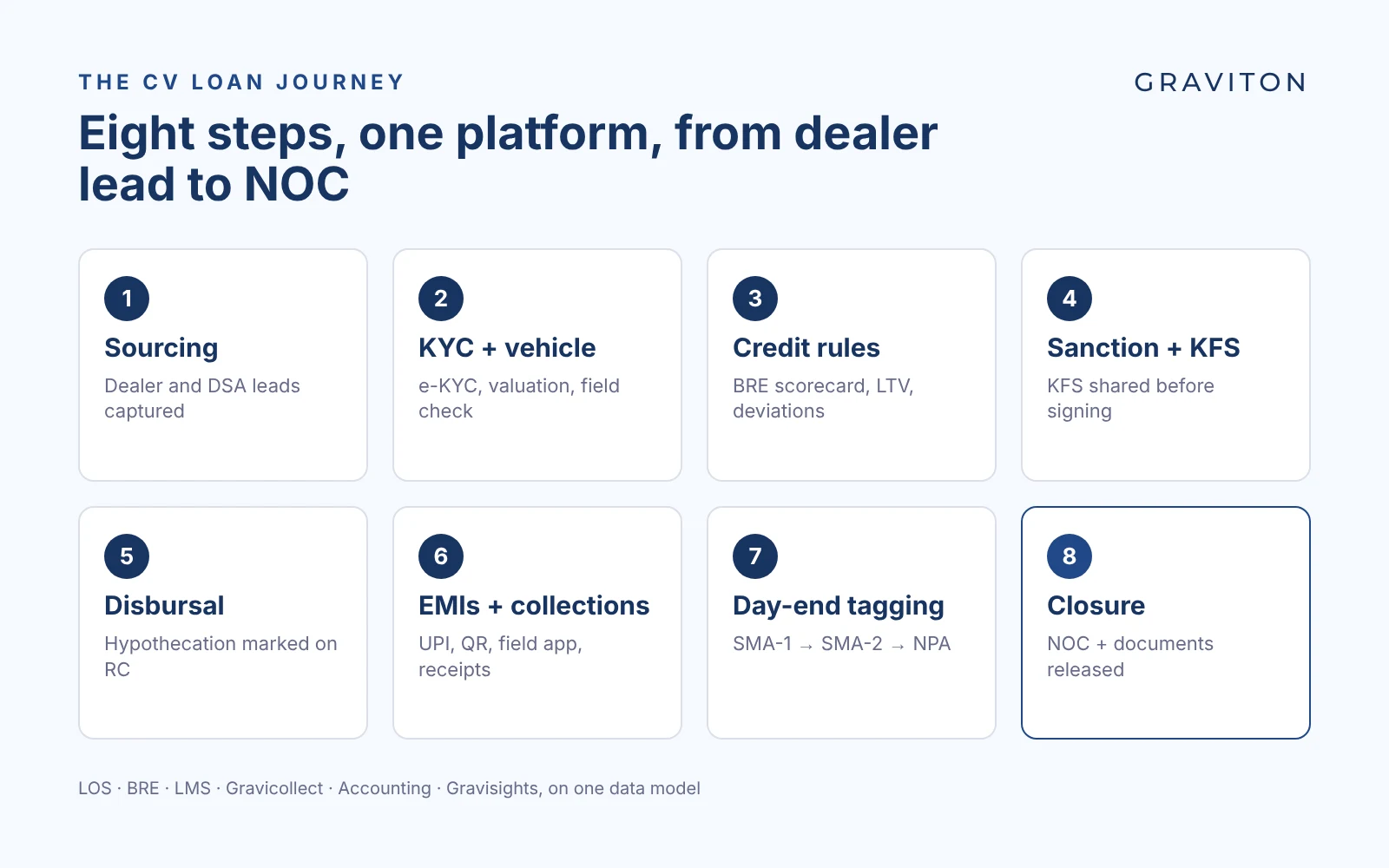
Every CV file has two credit stories: the borrower and the asset. Your LOS should capture vehicle category (SCV, LCV, ICV, M&HCV or bus), new or used, make, model, chassis and engine numbers, dealer and DSA, valuation and FI report, all inside one loan file. For used CVs, add vehicle age, inspection report and LTV checks, with deviations routed for approval automatically.
Ask the vendor: Can my credit team see valuation, FI and deviations on one screen? How do you track dealer and DSA performance? What sanction TAT do your live CV clients get?
2. Cash-flow-based underwriting rules
Salary slips tell you little about a truck owner. Your policy looks at driving or business experience, existing fleet, route, market load or attached contracts, plus bank statements and GST where available. A no-code business rules engine (BRE) lets your credit team set scorecards and LTV grids by segment, and change them when diesel or freight moves, without raising an IT ticket.
Ask the vendor: Can we run separate policies for first-time users, first-time buyers and fleet operators? Is every rule change version-controlled for audit?
3. Repayment schedules that match how trucks earn
Truck earnings dip in the monsoon and peak after harvest. Your LMS should offer step-up, step-down, seasonal and balloon schedules, part-prepayment and restructuring as standard products, not manual overrides. And every charge must match what was disclosed in the KFS, or you can't collect it.
Ask the vendor: Can I launch a seasonal EMI product without custom development?
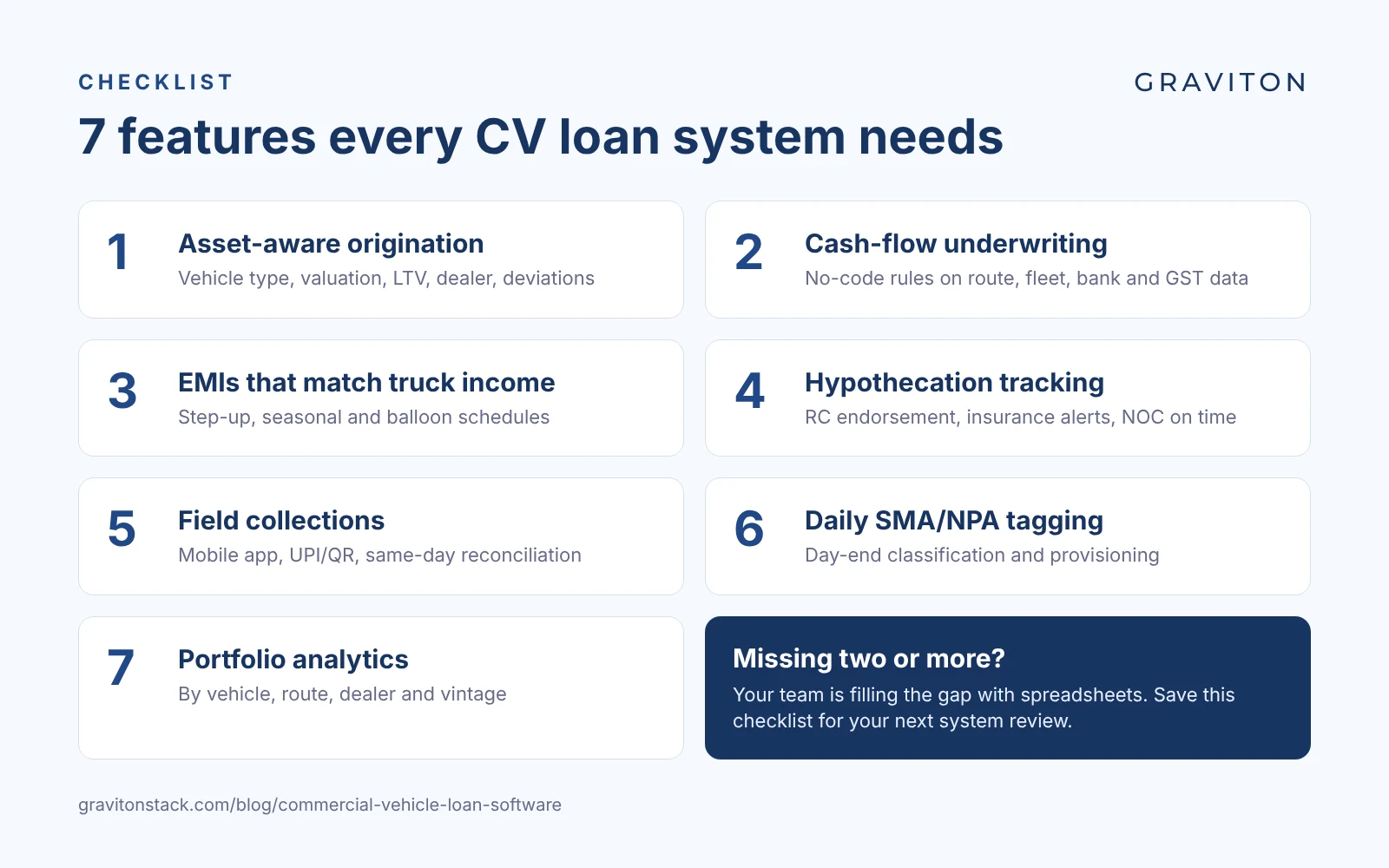
4. Hypothecation and document tracking, from RC to NOC
Hypothecation endorsed on the RC, insurance renewed every year: miss either and your security is weaker than your books say. At closure, a delayed NOC or original documents means complaints and regulatory exposure.
Ask the vendor: Do I get alerts before insurance lapses? Is NOC and document release a tracked workflow with timelines?
5. Field collections with same-day reconciliation
Your collection officers meet borrowers at transport nagars, loading points and on the highway. They need an app that works on weak networks, shows their allocation, accepts UPI and dynamic QR, and issues a digital receipt on the spot. Cash and digital collections should reconcile to the loan account the same day, so bounce follow-ups and repossession decisions start from accurate data.
Ask the vendor: What's the reconciliation cycle? Does the app capture geo-tagged visits and promises to pay (PTPs)? Are recovery-agent conduct rules built in?
6. RBI-aligned asset classification, every day
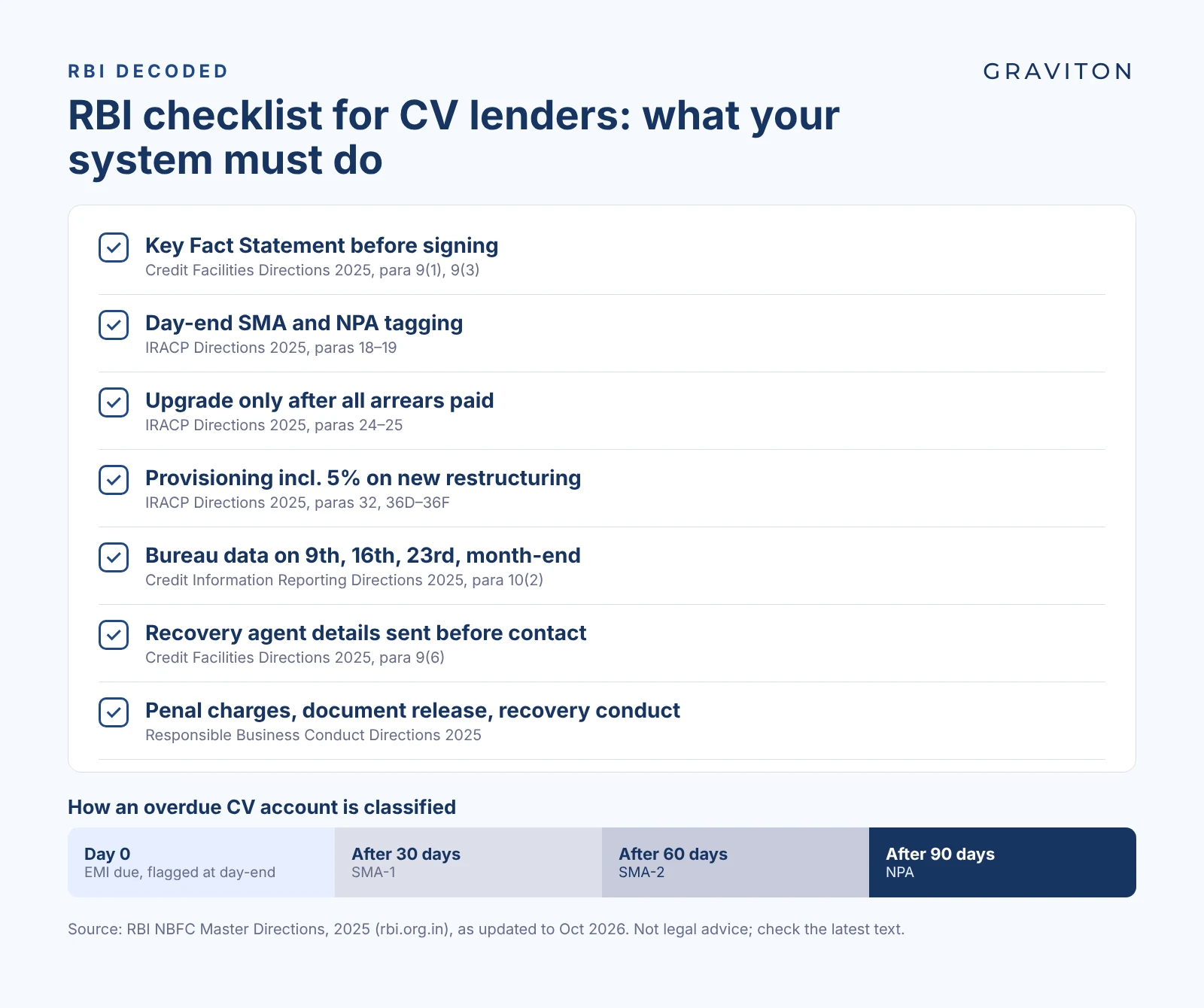
RBI's NBFC Income Recognition, Asset Classification and Provisioning Directions, 2025 require overdue flags to be set "as part of their day-end processes" (para 18). An account becomes SMA-1 after 30 days continuously overdue, SMA-2 after 60, and NPA after 90 (Illustration I). An NPA can return to standard only when "entire arrears of interest and principal are paid" (para 24). Doing this by hand across thousands of CV accounts is where errors and audit findings come from.
Ask the vendor: Is SMA/NPA tagging a day-end job or a monthly batch? Is provisioning linked to it automatically, with an audit trail?
7. Portfolio analytics by vehicle, route and vintage
CV risk clusters. A slowdown on one route, a model with weak resale, or a dealer sourcing poor files shows up in your bounce rates long before it shows up as NPA. You need dashboards that cut the book by vehicle segment, geography, dealer, DSA and disbursal month (vintage), with drill-down to the account.
Ask the vendor: Can my business head build these views without IT? Can I see vintage curves by dealer and DSA?
RBI compliance your CV loan system must handle
Since 28 November 2025, RBI has consolidated NBFC rules into 2025 Master Directions. Here's what a CV loan system must support, with the official source for each.
| Requirement | What RBI says | Source |
|---|---|---|
| Key Fact Statement (KFS) | NBFCs "shall provide a Key Fact Statement (KFS)"; digitally signed documents including the KFS "shall automatically flow to the borrower on the registered and verified email / SMS" | NBFC Credit Facilities Directions, 2025, paras 9(1), 9(3) |
| Daily SMA and NPA tagging | Overdue flagged in the day-end process; SMA-1 at 30 days, SMA-2 at 60, NPA after 90 | NBFC IRACP Directions, 2025, paras 18–19, Illustration I |
| NPA upgrade | Only when "entire arrears of interest and principal are paid", across all the borrower's facilities | IRACP Directions, paras 24–25 |
| Provisioning | 10% general provision on sub-standard assets; higher for doubtful assets by age; extra 5% for loans restructured under the new resolution chapter, released once 20% of the debt is repaid | IRACP Directions, para 32 and paras 36D–36F |
| Credit bureau reporting | Data as on the 9th, 16th, 23rd and last day of each month; increments within 4 days; full monthly file by the 5th; effective 1 July 2026 | NBFC Credit Information Reporting Directions, 2025, para 10(2) |
| Recovery agents (digital loans) | Agent's details sent to the borrower "through email / SMS before the recovery agent contacts the borrower" | Credit Facilities Directions, para 9(6) |
| Penal charges, document release, repossession, recovery conduct | Penal charges instead of penal interest, never added to the interest rate; original documents (including for movable assets) released within 30 days of closure, with ₹5,000 a day compensation for delay; repossession only as per the loan contract | Now in the NBFC Responsible Business Conduct Directions, 2025 |
How Graviton supports CV lenders
Commercial vehicle loans are one of Graviton's flagship products, from two-wheelers to heavy trucks, new and used. Origination, business rules, loan management, field collections (Gravicollect), accounting and analytics all run on one platform, with RBI-aligned controls built in. 48+ banks and NBFCs run on Graviton today, and lenders typically go live in 2–4 months.
See it with your own data. Book a 30-minute demo on a loan book shaped like yours.